

The Nightmare Factory
When a Creative Imagination Turns on You

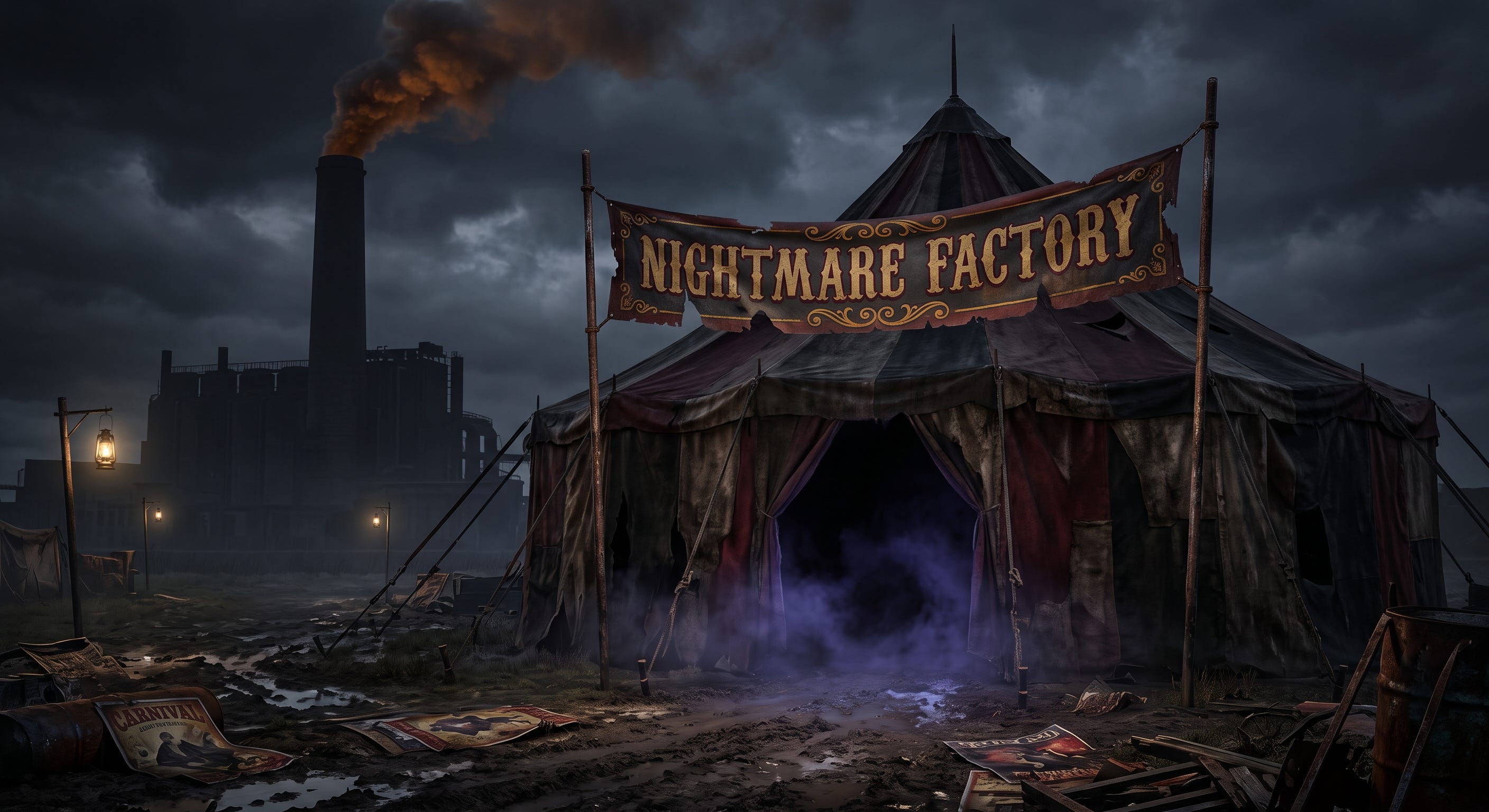
It’s no secret that creatives see the world through a slightly different lens. We build worlds out of thin air, conjure deep emotional arcs, and spend hours inhabiting the minds of characters who don’t exist. But what happens when the very engine that powers our art refuses to shut off when we close our eyes?
Recently, my friend and fellow writer, Bradley Ramsey, opened up about waking up emotionally wrecked from an excruciatingly long, hyper-detailed nightmare. He described it as his own personal torture chamber—a relentless, hours-long scenario built from real-world weight and trauma that left him completely drained before his day had even begun. He asked a simple, vulnerable question: Does this happen to other creatives?
Read the original note here:
The answer is a resounding yes. You are not alone.
If you’ve ever found yourself trapped in a nightmare that felt too detailed, too lingering, or too cinematic to be a “normal” dream, you aren’t crazy. You’re just experiencing the dark side of a highly attuned mind.
The Unfiltered Engine: Why Creatives Suffer Harder in Sleep
During waking hours, a writer’s or artist’s mind is constantly at work. We act as architects, editors, and directors. When a heavy thought, a past trauma, or a dark concept crosses our minds, our conscious brain steps in to filter it, shape it, or compartmentalize it. We build safe containers for dark ideas through our work.
When we sleep, however, the “editor” goes off duty.
During REM sleep, the conscious filters drop, but the creative engine keeps humming in the background. The difference is that now, you lose the steering wheel. What’s left is raw emotion, uninhibited imaginative depth, and hyper-vivid immersion. For a non-creative, a nightmare might be a vague sense of falling or showing up to school in only their undies (or less). For a creator, it’s a fully realized, three-dimensional narrative complete with atmospheric lighting, emotional gravity, and a warped perception of time that can make a few minutes feel like weeks.
It’s the ultimate double-edged sword: the very trait that allows us to create deeply resonant art is the same trait that gives our subconscious the tools to construct intricate torture chambers.
The Subconscious Pressure Valve
Dreams serve two primary functions for minds like ours:
Processing & Expelling: They act as a pressure release valve. Dreams are often our brain’s chaotic attempt to flush out or decompress thoughts, fears, and bottled-up energies that our waking minds refuse to give floor time to—or even consciously elect to filter out.
Uninhibited Exploration: Because our imaginative channels are naturally porous, the subconscious uses sleep to explore scenarios without the logical boundaries or moral hesitation of our waking self. This is where things tend to go off the rails.
Of course, knowing why it happens doesn't make waking up exhausted any easier. So how do we protect our sleep space when our own minds turn against us?
(A quick note: The following is not to be construed as professional medical advice, just casual insights drawn from my own personal experience. If you feel you may be struggling with a mental health condition, please seek guidance from a qualified professional.)
Energetic Hygiene: Practical Walls for Your Sleeping Mind
I firmly believe that energy isn’t just an abstract concept, but a tangible, invisible force that quietly dictates how we experience the world. Dark energy—whether it’s lingering stress, emotional fatigue, or past trauma—feeds on dark environments. To combat it, you have to actively introduce light and set clear boundaries before your head hits the pillow.
Here are three practical ways to establish baseline energetic hygiene for an active mind (Yes, I practice all three):
Shift the Frequency Before Bed
What you consume in the final hour before sleep acts as raw material for your subconscious. If you’ve spent the evening ruminating on dark topics, staring at heavy news, or—as is the case for many of us—actively consuming or writing horror content, you’re handing your inner nightmare architect a fresh set of tools.
Give those sleep demons a few hurdles to jump through. Watch lighthearted comedy, listen to uplifting music, or engage in something entirely low-stakes before bed. Force your brain to shift frequencies.
Exorcise the Content on Paper
It sounds counterintuitive to write down something you’d rather forget, but keeping a dream journal is a powerful act of externalization.
When you write a nightmare down on paper, you take it out of your head and put it into the physical world. In doing so, you strip away its hidden power. Seeing a string of troubling or recurring themes laid out in ink allows your waking, analytical mind to say, “Ah, that’s what you were trying to deal with.” Once a thought is named and understood, you can come to terms with it—and banish it for good.
(I know, I know… more writing projects. Sorry.)
Physical Grounding and Release
(Making up for adding to your writing workload.)
Sexual stimulation or physical release is another great way to prep your subconscious before sleep. I will leave the particulars to your own preference/situation, but you get the idea. It’s an incredibly effective way to ground yourself in your physical body, release built-up tension, and trigger a natural wash of endorphins that shifts your brain out of dark or anxious cognitive loops.
Metaphysical Boundaries: A Little Night Magic
If, like me, you lean toward the spiritual, or if you simply find comfort in physical rituals, there are a few highly accessible metaphysical tools you can use to protect your sleep space. You don’t need any deep knowledge of witchcraft for these to be effective; they are simply physical anchors for your intentions.
Set Intentions and Cast a Minor Ward
Regardless of where you land on personal beliefs, there is immense psychological and spiritual power in verbalized intention. Before you go to sleep, set a firm boundary for your mind.
While lying in bed right before closing your eyes, say out loud, three times: “No bad dreams.”
Focus deeply on those words and the intent behind them. If you sleep with a partner, have them join you in the incantation. Let that phrase repeat gently in your mind like a shield as you drift off. Think of it as casting a minor protection ward over your subconscious space. You aren’t trying to stop dreaming altogether—you’re simply declaring that the nightmare factory is closed for the night.
Crystal Anchors
Keeping a specific stone on your nightstand or tucked beneath your pillow or mattress is a great way to anchor the energy of your sleep space. Amethyst is famously used to soothe anxiety, clear the mind, and promote restful sleep. Alternatively, Black Tourmaline is an excellent, low-maintenance stone for absorbing and repelling dense, dark energy before it can reach you.
Herbal Dream Defenses
Scent is heavily tied to memory and the subconscious. Creating a simple herbal sachet (just a small muslin bag or tied-off cloth) to keep inside your pillowcase can subtly signal to your brain that it is safe to rest. Lavender and chamomile are incredible for inviting peace, while a pinch of dried rosemary has been used for centuries specifically to ward off nightmares.
Take Care of the Vessel
Living with a vivid, highly active imagination is a rare gift, but on the morning after a horrific nightmare, it feels like a heavy burden. If you wake up emotionally drained, treat it just like physical exertion. Take it easy, give yourself room to recharge, and remember that your mind was just running a marathon in the dark.
Most importantly, remember that you don’t have to carry that exhaustion alone. The dark thrives in isolation, and as Bradley’s vulnerable question proved, simply talking about our nightmares helps strip them of their power.
Your creativity is a powerful tool. You just have to make sure you’re the one holding the reins.
So, Fellow Creatives with Restless Minds: How do you handle the “nightmare factory” when your creative brain won’t shut down? Do you use a dream journal, or do you have your own specific methods (practical or metaphysical) for directing your subconscious before sleep? Let’s talk about it in the comments below—you might just help a fellow creative get a good night’s rest.
Peace.
This is good, and it resonates
The idea of the “editor” going off duty while the creative engine keeps running is such a good way to describe this. I’ve definitely had those ridiculously detailed dreams where you wake up wondering how your brain managed to build an entire world, plot, atmosphere, and emotional arc while you were supposedly resting. 😂 I also love the idea of getting it onto paper afterward. If my subconscious insists on running the nightmare factory overnight, I might as well steal some material from the night shift. Great piece, L.G.!