

The Black Swan
A Horror Short for Friday the 13th

In true L.G. Wells form, a note before we begin: This story contains intense horror elements, including depictions of bodily injury, death, psychological distress, and references to self‑harm and suicide. Reader discretion is advised.
Friday, February 13, 2026
Julian Thorne didn’t believe in luck; he believed in design. Luck was for the people who played the lottery or waited for the bus—the desperate who hoped for the best because they lacked the power to demand it. Success was what happened when you forced the world to match your design.
He stood in his penthouse kitchen, the aroma of $110-a-bag espresso cutting through the clinical austerity of Calacatta Borghini marble and low-iron Starphire glass. He reached into the pocket of his silk robe and produced a pair of dice. They were solid ivory, yellowed slightly by the oils of his skin, heavy and honest.
Every morning for fifteen years, Julian had rolled them. They were the only crack in his armor, the sole allowing of chance in a life otherwise paved in cold, hard certainty. A high total meant an aggressive day—buy, fire, expand. A low total meant consolidation—wait, watch, bleed them dry. The dice had never lied. They were as essential as his heartbeat, and twice as reliable.
He tossed them.
Click. Clack.
The first die settled quickly: a six. The second die skittered toward the edge of the island, spinning like a top before it dropped flat.
Julian leaned in, his brow furrowed.
The die showed a six. But there was something else. Right in the center of the six pips, where the white space should have been, sat a seventh mark. It was perfectly circular, blacker than the ink on a liquidation notice, and seemingly recessed into the ivory.
He reached out to smudge it away, expecting lint or a drop of spilled espresso. His thumb moved over the surface, but the mark didn’t move. He scraped it with a manicured nail, digging until the skin of his finger turned white. The mark remained—the roll—a perfect, impossible thirteen.
“Black swan,” he whispered. His voice sounded thin in the cavernous kitchen.
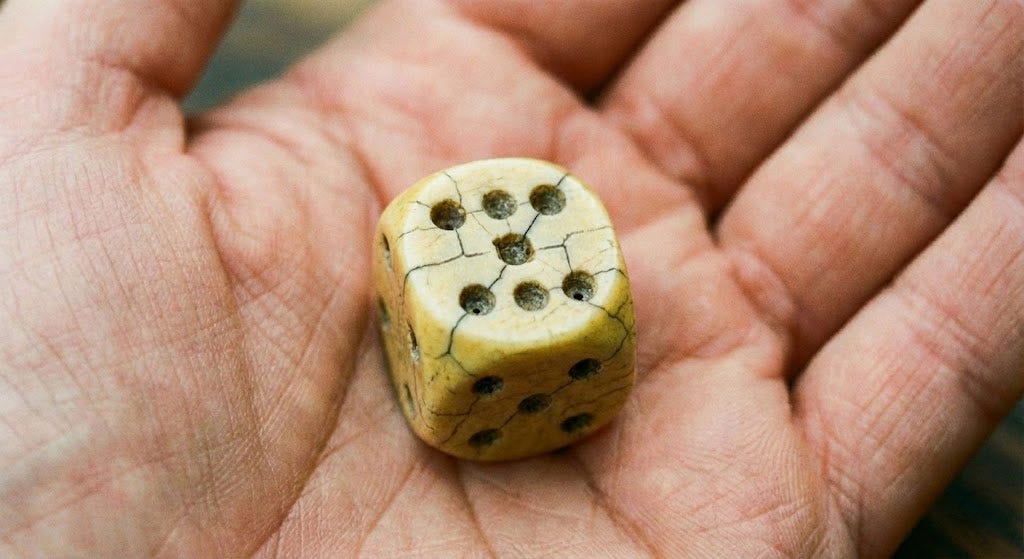
He picked up the die. As he turned it in the light, the seventh mark seemed to stay fixed, as if it weren’t painted on the ivory but was a hole in the air itself, a puncture in the fabric of his vision. It pulsed with a sluggish, heavy rhythm, a fixed point in a world that had suddenly lost its axis.
He didn’t call a doctor. Doctors were for people who didn’t understand how systems worked. Instead, he stood there for a long minute, watching the black mark occlude the gold leaf on his kitchen cabinetry, waiting for the “glitch” to reset. It didn’t. The penthouse began to feel like a Hollywood set—the marble too white, the silence too thick.
He retreated to his dressing room and pulled on a charcoal pinstriped suit that cost more than his security guard’s annual salary. It was his armor, but as he cinched his silk tie, the seventh mark hovered directly over his reflected pupil in the mirror. It looked as though something small and stocky was peering out from the center of his brain.
Julian forced a breath, tasting the expensive espresso and the metallic tang of a rising panic. He turned away from the glass, but the mark followed, a persistent smudge on the periphery of everything he saw. He grabbed his briefcase—heavy, textured, indisputably real—and headed for the door. The apartment was no longer a sanctuary; it had become a cage of white marble and impossible geometry.
He needed to be at the center of the world. He needed the noise of the floor, the flicker of the terminals, and the cold certainty of the ticker. He needed to prove that thirteen was just a prime number, not a prophecy.
The lobby of the Thorne Building was a cathedral of steel and ego. Julian marched toward the private elevator bank, the ivory dice clicking together in his fist like teeth.
“Morning, Mr. Thorne,” the security guard said.
Julian cast a glance in the direction of the voice, then looked away. Through the “hole” in his vision—the mark that had migrated from the die to his right eye—the guard didn’t look like a man. He looked like a series of ticking clocks, many of them rusty, all of them spinning unnaturally fast.
He stepped into the express elevator and pressed the button for the 42nd floor. The top floor. His floor. The doors slid shut, the gold-leaf interior reflecting a distorted, pale version of himself.
The elevator began its smooth, silent ascent. 10… 11… 12…
The digital display flickered—went momentarily black. Then the number 13, which Julian had personally ordered removed from the building’s sequence years ago, flashed on the screen in a garish, neon green.
The elevator shuddered to a halt. Julian’s briefcase slipped from his numb fingers, striking the floor with a heavy, deadened boom that seemed to vibrate through his teeth. His breath hitched, a cold, oily sweat breaking across his brow. He reached for the brass handrail, his knuckles white, his mind frantically running through the symptoms of a stroke or a sudden, stress-induced psychotic break. This was a deviation outside the standard deviation. His heart hammered a frantic, uneven rhythm against his ribs, a wild protest against a reality that had suddenly stopped making sense.
The doors didn’t slide open with their familiar hydraulic hiss; they peeled back like skin—a wet, tearing sound that vibrated in Julian’s jaw.
Julian felt a phantom weight, cold and irresistible, press against his spine—a shove from a hand that wasn’t there. He was pitched forward, stumbling out into the impossible. Before him, a corridor stretched into a featureless, grey oblivion—a horizon of nothingness where the rest of the city should have been. The floor was stone, topped by a rug the color of dried blood, and the air smelled of wet copper and burnt matches. It was a pier built over the end of the world.
Heart hammering, he spun around to retreat into the safety of the elevator.
But the elevator was gone.
In its place was a solid wall of ivory. Dominating the heart of that bone-white expanse was a black door, and at its very center, a heavy, antique brass knocker in the shape of an unblinking eye.
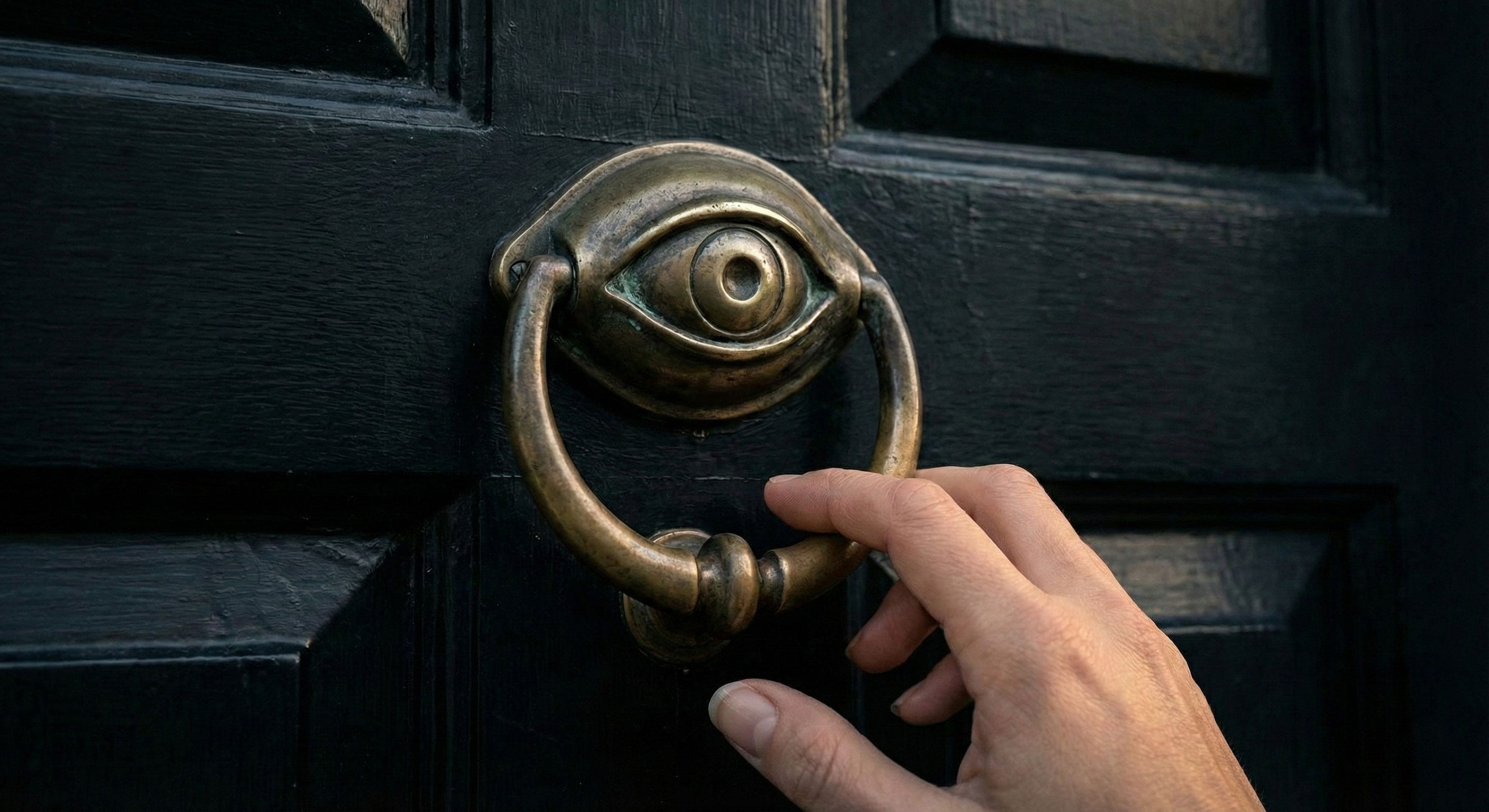
An unseen magnetism seized Julian’s arm, dragging his hand toward the heavy brass with a strength that brooked no resistance. Julian reached for the knocker—the metal felt warm, pulsing like a living eyelid—but before he could release it to make a sound, the door swung inward on silent hinges.
The room was his boardroom, but the proportions were wrong. The mahogany table was miles long, and seated around it were thirteen figures. They wore the suits of executives, but where their faces should have been, there were only the jagged, flickering images of the lives he had liquidated.
One figure’s head was a repeating, low-frame-rate stutter of a car plunging from a cliff; another’s was the jagged, concave horror of a crushed skull, a gray-scale loop of the moment a subpar factory support beam—one Julian had deemed too expensive to replace—had finally failed. To Julian’s right, a creature in a sharp charcoal blazer possessed a face that was merely the static-filled image of a candlelit, but empty bedroom. They sat with their hands folded over the mahogany, their fingers translucent and smelling of wet earth.
The man at the head of the table stood—The Chairman of this silent, flickering board. His skin was the texture of ancient, yellowed parchment, and his eyes were empty holes. “We have been feeding on the cold ash of the lives you burned, Julian,” the thing hissed, its voice the sound of a thousand shredders. “We,” the man gestured to the others seated at the table. “We are those lives.” He leaned forward, the dry parchment of his skin creaking as he rested his skeletal digits on the mahogany. “In a void where time is measured only in the screams of the broken, we waited for the gate to open. You summoned us with that impossible thirteen, and we have come to answer with our hunger.”
The figure with the crushed skull stood, his chair screeching against the smoldering floor. “We bartered our eternal rest for this hour, Julian. We gave up the silence of the grave for the sound of your breaking bones. We do not want your gold; we want the heat in your veins to pay for the winter you left in our hearts.”
A woman at the far end, her face a flickering loop of her own eviction, stood up. “The Black Swan has landed, Julian, and its wings are made of fire and brimstone. We will peel away your lies until nothing remains but the raw, red truth of what you are.”
The Chairman’s hollow gaze widened. “Let us start with this skin you call a suit.” He gestured, and the charcoal pinstripes began to smoke, turning into charred ribbons that clung to Julian’s flesh like hooks of molten iron, flaying the skin back to reveal the pulsing, raw muscle beneath.
“Noooo!” Julian wailed as he backed away, his heels clicking frantically on the smoldering stone beneath his feet.
They moved toward him as a single entity, not walking, but expanding—filling the room with the stench of sulphur and revenge. He hit the ivory wall where the elevator had been—solid, monolithic, a dead end. Panic shrieked in his mind as he spun, his fingers scraping against the bone-white expanse, frantically searching for the black door he had entered through moments ago, but it seemed to have vanished into the oppressive geometry of the room.
The woman with the face of shifting static was suddenly there, her movement a blur of shadow. She didn’t smell like sulphur; she smelled of the expensive perfume he’d bought her a lifetime ago, mixed with the salt of tears and the rot of the grave. “Lover,” she whispered, her voice a jagged caress. She cupped his flayed jaw with fingers like frozen needles, the gesture baring the blue slits in her wrists—a stark, silent reminder of her final act.
He tried to scream, but she leaned in, her mouth hovering inches from his. When she kissed him, it wasn’t an act of love; it was an undoing. She locked her frigid lips to his, and he felt the very air being yanked from his lungs. His chest collapsed inward, his ribs creaking under the pressure as she drank his breath, his warmth, the very rhythm of his life. His vision swam with grey spots; he was a ragged, bleeding husk, his knees buckling on the burning stone.
With a final, desperate convulsion of terror, Julian tore himself away, the skin of his lips sticking to hers before ripping free, strands of moisture stretching and snapping as a patch of his lip came away. Gasping, a thin, wheezing sound whistling through his throat, his flailing hand struck a hard, cold edge…
The doorway, the corridor just beyond. A surge of frantic relief, sharp and misplaced, flooded through him as the black door materialized beneath his palms, a solid exit from the room’s impossible weight.
He lurched.
He scrambled past the black door, his naked, scorched body steaming and raw against the cold wind of the void. Behind him, the silence was torn open by a cacophony of shrieks and wet, rhythmic thuds.
“Thief!” The Chairman howled, a sound like grinding stone. “Usurer! Thief of a thousand lives!”
The ghouls didn’t run; they surged, a black tide of flickering faces and grasping limbs, their footfalls beginning to lose their human softness, sharpening into the frantic, bone-deep clatter of hooves upon the stone.
The hallway narrowed, the ivory walls pressing in like a constricting throat, slick with the sudden heat of their pursuit. Julian’s heart hammered against his crushed ribs, a frantic, dying animal. He could feel the draft of their reaching hands, cold fingers brushing against his raw heels, the stench of sulphur and old grief thickening until he was choking on it. The oblivion ahead was no longer grey; it was a hungry, perfect black that seemed to pull the light from his very eyes.
Julian reached the edge of the stone. He looked back. The things were inches away, their hands reaching out like grasping claws made of shadow and bone.
He didn’t think about the odds. He didn’t check the forecast. For the first time in his life, Julian Thorne made a decision based on nothing but pure, unadulterated terror.
He stepped into the nothingness.
The morning air on 5th Avenue was crisp, though in the predatory rush of Manhattan, few people noticed the scorched, broken man lying on the asphalt. They were too tied up in the clockwork of their own shit—their commutes, their coffee, the frantic alignment of their own lives—to look down at a man who had fallen from nowhere.
The first officer on the scene, a rookie named Miller whose breakfast was already threatening to revisit him, knelt beside the remains. He had seen jumpers before, but never anything like this. The man was flayed raw, his flesh scorched as if he’d been pulled through an incinerator, yet the body was ice-cold to the touch.
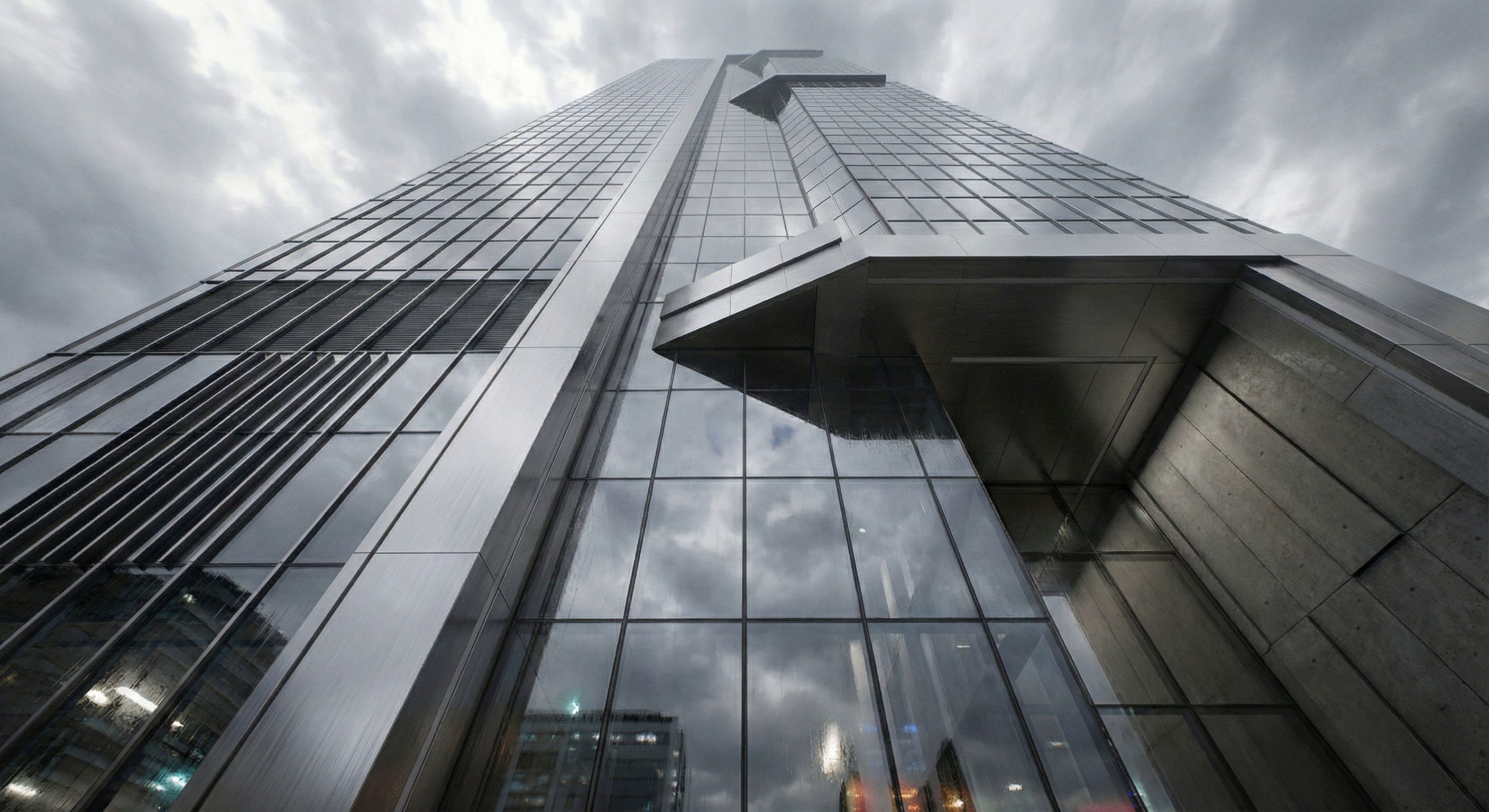
Miller shielded his eyes and looked up at the monolithic face of the Thorne Building. He counted every floor, searching for the shattered glass or the swinging casement that had birthed this nightmare, but the facade was a perfect, unbroken grid of steel and reflection. Not a single window was open; not a single pane of glass was broken on any of its forty-two floors.
He looked back down, swallowing hard. Miller reached out a trembling hand to check for a pulse, a hollow gesture he knew was futile. As his fingers brushed the frigid, raw meat of the neck, the dead man’s clenched fist, resting just inches from the concrete curb, suddenly spasmed and fell open.
A pair of ivory dice spilled out, carrying the unnatural, residual momentum of his impossible descent. They didn’t just fall; they struck the pavement and rolled with a frantic, clattering energy, as if they had been cast by an invisible hand. Miller recoiled as they skittered across the pavement, bouncing off the curb with a rhythmic, final clatter as the first siren wailed in the distance.
The dice finally settled.
The first die came to rest: a six.
The second die tumbled, hit a crack in the pavement, and dropped flat.
It was a six… but with a black, impossible hole pulsing in its center—a seventh mark.
Julian’s final roll.
A total of thirteen.
Staring up from the gutter at the indifferent city.
Wonderful story telling! 13 and Friday the 13th have always been lucky for me! This year was no exception! Creepy!
Really enjoyed this one. Major Clive Barker vibes, especially “cabal”, if you are familiar with that one.