

Samantha's Song

Author’s Note: As a year-end gift to my readers, what follows is the holiday serial Samantha’s Song, presented here in its entirety. Settle in, grab a warm beverage, and enjoy the journey from beginning to end. Make sure to scroll to the end for a special musical pairing.
Chapter One
M.D. Anderson Cancer Center
Houston, Texas – December 2004
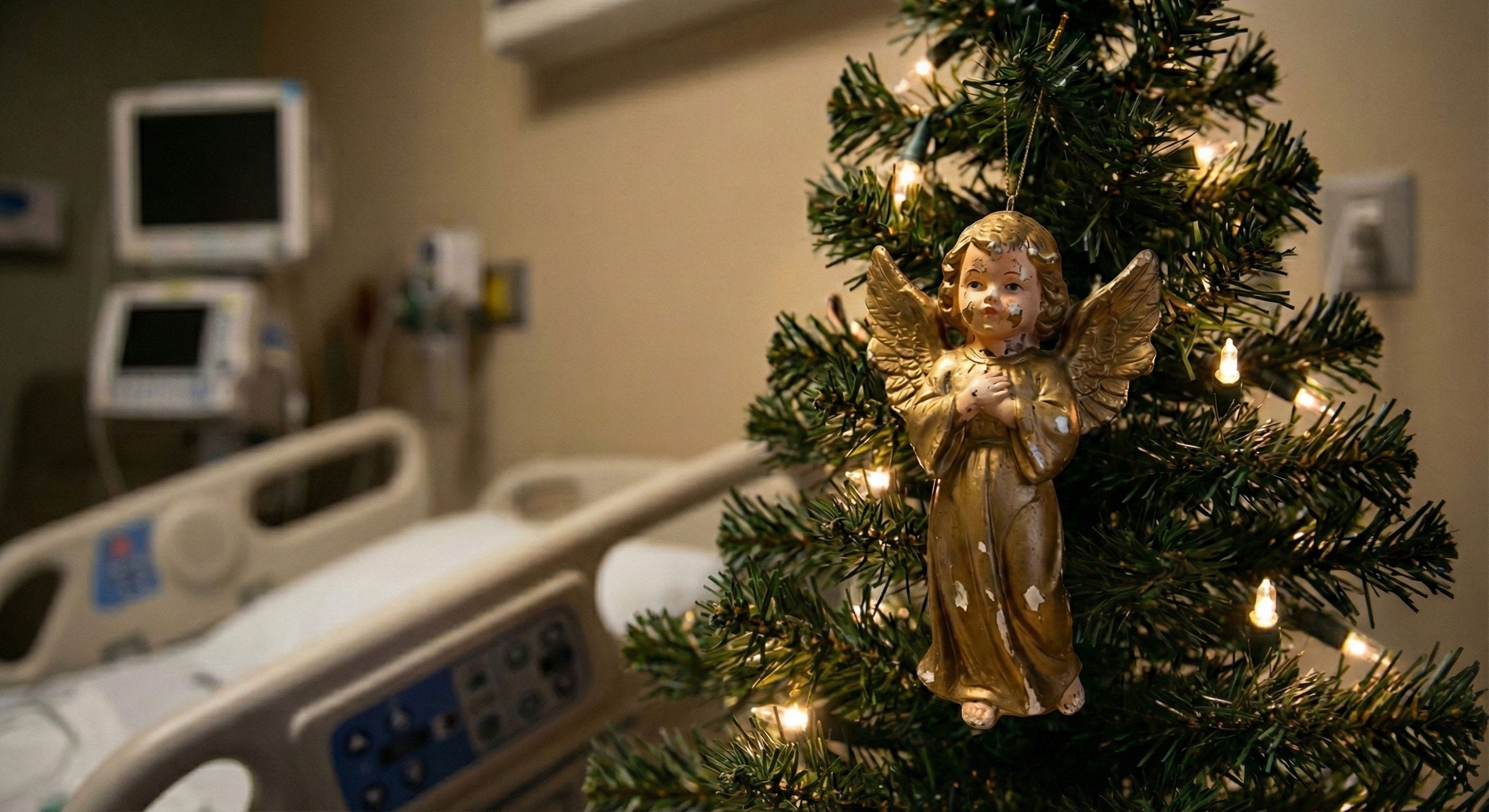
The halls of the hospital didn’t smell like Christmas. They smelled of floor wax, industrial lemons, and a sterile, biting stillness that made seventeen-year-old Ben feel like the air itself had turned to lead. He was seventeen, his voice finally settling—after spending most of his junior high years as a struggling alto—into a rich, soulful tenor his teacher promised would “take him places.” But in the pediatric wing, his voice felt small.
The choir was halfway through a quiet, reverent rendition of “Silent Night.” It wasn’t a rigid performance; they were just a loose collection of volunteers wandering the corridors, trying to be “cheerful”—a word that felt increasingly hollow with every room they passed.
Then, he felt a tug.
A little girl, no older than seven, stood by his side. She was wearing a knit hat with a lopsided snowflake and a hospital gown that looked three sizes too big.
“Can I sing with you?” she whispered.
Ben didn’t hesitate. He stood away from the wandering group of singers and reached down. “Of course you can,” he smiled, offering his hand.
When she took his hand, the sensation carved itself into his soul. Her skin was deathly cold—the kind of chill that comes from a long, internal winter—yet there was a “fiery warmth” beneath it, a stubborn, electric pulse of life.
“I’m Sam,” she said, her voice a tiny, clear bell. “Short for Samantha.”
They walked the length of the wing together. Ben stopped singing the lyrics; he just hummed the melody so he could hear her. She knew every word. She led him to a doorway where a man and a woman stood, their faces a map of exhaustion and fragile hope.
“She sings constantly,” her mother, Melissa, whispered as the song ended. “I think it’s the only thing that keeps her going.”
Before leaving, Ben tentatively held out his phone to the father. “I’m Ben,” he said, his voice thickening as he looked from the man to the girl. “If it’s alright... I’d really like to check in on her. To know how she’s doing.”
“Of course,” the man said, his eyes glassy as he took the phone to enter his information. “And it’s so nice that you guys are here. It really means a lot to us... to her.”
As Ben turned to rejoin his group, he felt another tug on his sleeve. While he’d been talking to her father, Sam had slipped away for a moment, disappearing into the room behind her where a tiny, battery-operated Christmas tree sat on the bedside table. She held out a small, cheap plastic angel ornament—the kind that came in a bulk pack, with gold paint that was already starting to flake.
“For you,” she whispered, pressing the ornament into his palm.
Ben looked down at the tiny figure in his hand. He caught one last look at her, noticing a sparkle in her eye—a strange, defiant light that he couldn’t quite place. He wondered how there could be happiness in a place such as this, but he found himself hoping that maybe, even if just for a brief moment, he had something to do with it.
New Year’s Eve...
Ben’s phone buzzed on the bedroom dresser at 6:00 PM. He was standing in front of the mirror, fumbling with his tie and humming scales, getting ready for the New Year’s Eve showcase. It was supposed to be the biggest night of his young life—the moment he stepped out as a lead tenor. He saw the name flash across the screen—the one he’d saved just days before—and felt a surge of adrenaline.
He snatched the phone up before the second ring, a wide grin splitting his face. He imagined her on the other end, maybe laughing... probably singing... he chuckled at the thought.
“Happy New Year, Sam!” he shouted into the receiver, his voice bright with the effortless confidence of a boy who hadn’t yet learned how fast a heart could break.
“Ben?”
The voice on the other end wasn’t a tiny bell. It was Melissa. Her voice was hollow, sounding like a house after the heater stops working. “She’s—” Her voice cracked, a jagged, raw sound that cut through the celebratory hum of the house.
There was a long, heavy silence. Ben held his breath, his tie still half-looped, the silence on the other end feeling like a rising tide.
Then, a man’s voice took over—the father, his tone thick but steady with a devastating, brittle strength. “She’s gone, Ben. Christmas evening. She... passed peacefully. We thought you would want to know. She couldn’t stop talking about you... she swore you were an angel.”
The silence that followed wasn’t just a sound; it was a flatline. Ben stood in the bedroom, the phone pressed to his ear until his arm went numb, his tie hanging half-finished around his neck. He looked at his hand—the one she had held. It felt like the warmth was draining out of his fingertips, replaced by a permanent, biting frost.
“I’m so, so sorry,” he finally whispered into the receiver, his voice barely audible over the rush of blood in his ears.
He didn’t cry that night. The New Year’s Showcase didn’t care; the world outside his window was still counting down, the lights of the stage were still being tested, and the audience was still waiting for a song. He decided then that if he was going to sing, he was going to sing loud enough for the ones who couldn’t.
Chapter Two
Present Day – New York City
Twenty years later, the “fiery warmth” had been replaced by pyrotechnics.
Ben Thorne stood backstage at a sold-out Madison Square Garden. The arena buzzed, twenty thousand fans chanting his name. He was the lead singer of The Echoes, the biggest rock band in the country. He had the entourage, the platinum records, and the reputation for being “brooding.”
The industry called it an “image.” Ben called it a cage.
His biggest hit, “Samantha’s Song,” was the finale of every show. It was a soaring rock ballad that had topped the charts for months. But every time he sang it lately, he felt like a thief. He was selling her memory for $150 a ticket.
“You good, Ben?” his manager asked, clapping him on the shoulder. “Huge crowd tonight. The network’s live Christmas special, streaming to over twenty million people. Keep the label turned out on your beer tonight, Ben—I’m serious. They’re already breathing down my neck, and the sponsor is looking for any excuse to drop us after that TMZ bit about you swapping their lager for whiskey in the prop bottles because you couldn’t stand the taste.”
Ben didn’t answer. He stepped out into the blinding white spotlights. The noise was a physical wall of sound.
The set was a blur of high-octane artifice. To those in attendance and the twenty million people watching the stream, Ben was electric—a dervish of leather and sweat, hitting every mark with a jagged, desperate energy. But for him, it was pure monotony. He was a veteran actor playing the role of a rock star, his fingers moving to chords he could play in his sleep while his mind wandered to the whiskey-filled prop bottles and the crushing weight of his loneliness.
The band closed the main set with a thundering, pyrotechnic anthem that shook the stadium’s foundation. Ben shouted a breathless “Thank you, New York! Goodnight!” into the mic, and the stage plunged into a calculated darkness. The band retreated to the wings, but the audience didn’t budge. The roar didn’t fade; it morphed into a rhythmic, deafening chant that pulsed through the floorboards: “EH-CHOES! EH-CHOES! EH-CHOES!”
After three minutes of letting the tension simmer, Ben stepped back out alone. He carried the legendary 12-string—a guitar that was more an icon than an instrument. It was stark white and encrusted with hundreds of tiny mirrored tiles that caught the overhead beams, fracturing the light into a thousand shimmering needles. It looked angelic, glowing with an ethereal brilliance that had defined the “Samantha’s Song” music video for a generation.
The crowd erupted, a wall of sound so loud it almost knocked him back. Then, as the manufactured snow began to drift down from the rafters, the silence became absolute. He hit the first ringing chord, feeling the familiar hollow ache in his chest. This was the moment they paid for.
“I met a girl in a hallway of white / She held my hand and gave me sight...”
Ben looked out into the front row. Usually, he registered only a blur of blue-lit phones and screaming, distorted faces. But tonight, right against the cold steel of the barricade, the chaos seemed to hit an invisible wall.
There sat a young girl in a wheelchair, an oxygen tank tucked discreetly beside her. She was wearing a knit hat with a lopsided snowflake, her small frame swallowed by a heavy coat. She wasn’t cheering. She was just watching him, her eyes wide and knowing, as if she could hear the notes before he even played them.
Behind her, her parents stood close, their hands clasped tightly together as if they were holding each other upright. Each had a hand resting on the girl’s shoulders—steady, grounding, and fiercely protective. Their eyes were wet, shimmering under the sweep of the stage lights, and as they looked from their daughter to Ben, their expressions told the only story he needed to know. It was a look of exhausted love and a silent, desperate thank you for a moment they all knew was borrowed.
Ben’s throat seized. The “cold” returned to his hand, so sharp it felt like his fingers would snap against the guitar strings.
He missed a lyric. Then another. The band faltered behind him.
“Ben!” the stage manager yelled into his in-ear monitor.
He looked at the girl again. She smiled—a small, sad smile that said You forgot why you started.
He didn’t finish the verse. He didn’t say goodbye. He dropped his guitar, the feedback shrieking through the arena like a wounded animal, and walked off the stage.
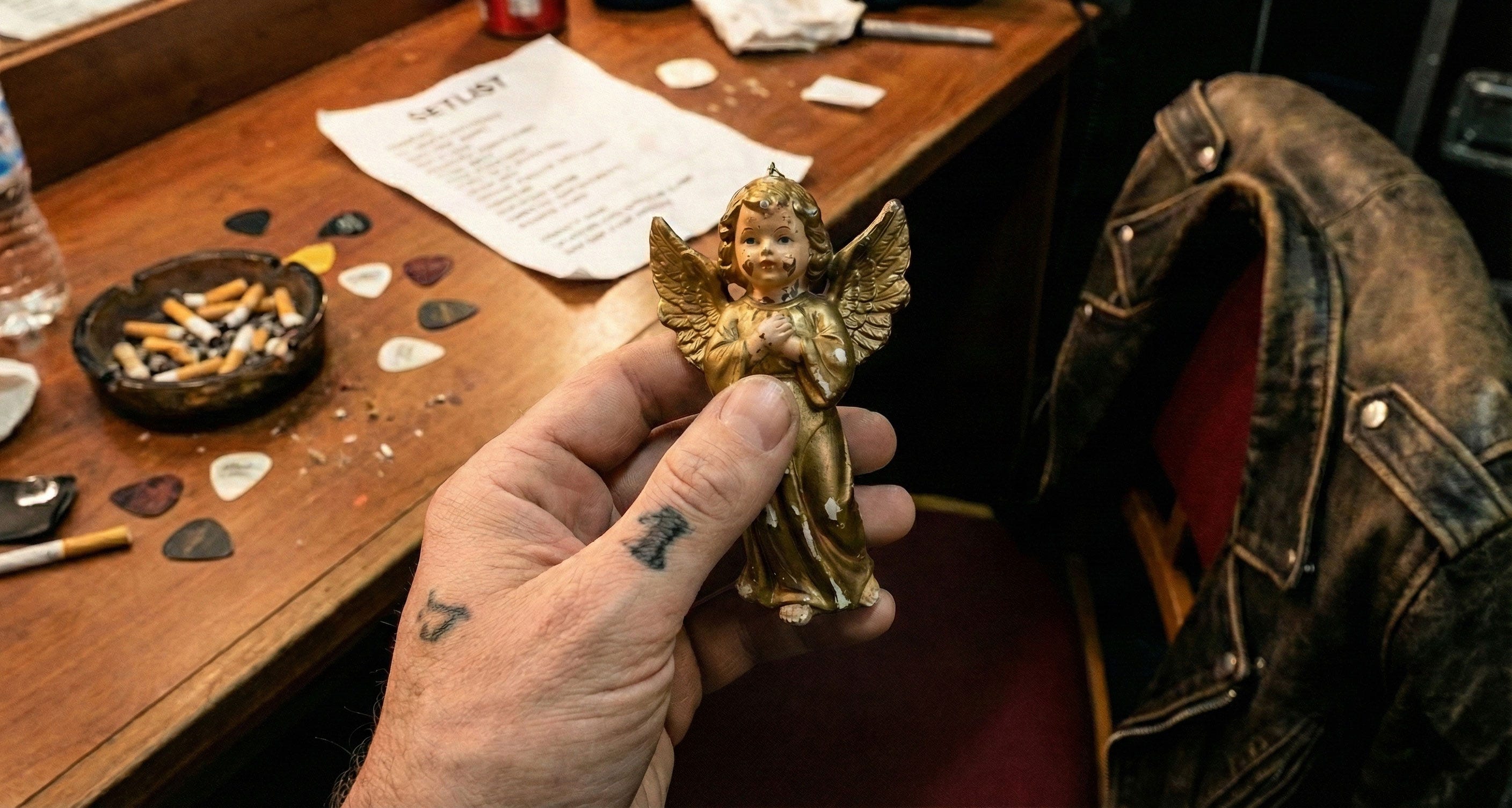
By the time his manager reached the dressing room, Ben was gone. He left his phone, his wallet, and his career on the vanity table. He only took one thing: a small, chipped plastic angel ornament. The gold paint was mostly gone, worn away by twenty years of being carried in his pocket or held during long nights on the tour bus.
He drove north until the city lights were a memory and the snow began to fall. No stagehands. No manufactured magic. Just the cold, white truth of whatever lay before him.
Chapter Three
Somewhere in the Adirondacks, New York
Ben didn’t have a destination. He just had the road and the rhythm of the windshield wipers, which seemed to be trying to scrub the image of the girl in the wheelchair from his mind. He’d been driving for four hours, the heater in his high-end SUV blasting against the encroaching chill of the mountains.
The roads grew narrower, winding like a serpent through the skeletal trees. The GPS had given up an hour ago, showing only a blue dot spinning in a sea of gray. He didn’t care. He wanted to be lost. He wanted the world to stop chanting his name.
Then, the car shuddered.
A violent thump-thump-thump vibrated through the steering wheel. Ben gripped the leather-wrapped wheel as the back end of the vehicle fishtailed in the deepening slush. He eased off the gas, wrestling the two-ton machine until it lurched to a halt on the shoulder of a road that looked more like a logging trail.
“Dammit.” He slammed his palm against the steering wheel, his mind racing through a list of options—each one worse than the last. He glared at the rearview, hoping for a miracle, but the roadside assistance light just pulsed a steady, mocking red. No signal. In this notch of the mountains, he was officially off the map. Steeling himself, he killed the engine, tossed his keys on the passenger seat, and stepped out into the Adirondack night.
The cold hit him like a physical blow. He was still wearing his stage clothes—thin black denim and a silk shirt that offered zero protection against the harsh mountain winter. He looked at the rear tire. It was shredded, likely victim to a rusted logging spike hidden beneath the slush.
He heaved open the rear hatch, the SUV’s interior lights casting a cold, artificial glow over the snow. He actually managed to get the jack positioned—the muscle memory of a driveway in Houston, twenty years ago, fighting through the numbness in his fingers. But as he dragged the spare out, he felt a sickening give. It was a pancaked rim of rubber that had succumbed to a slow leak in a climate-controlled garage.
“Always check the spare before a road trip.” His father’s voice echoed in his mind, unbidden and annoying. He supposed his dad should have told his people to check it, because Ben hadn’t touched a tire iron in a decade. He slammed the hatch shut, the sound flat and hollow against the rising wind. Through the rear glass, he could still see the roadside assistance button pulsing, a rhythmic red reminder that no one was coming.
The silence of the woods was absolute. No fans. No pyro. No feedback. Just the soft, heavy sound of falling snow.
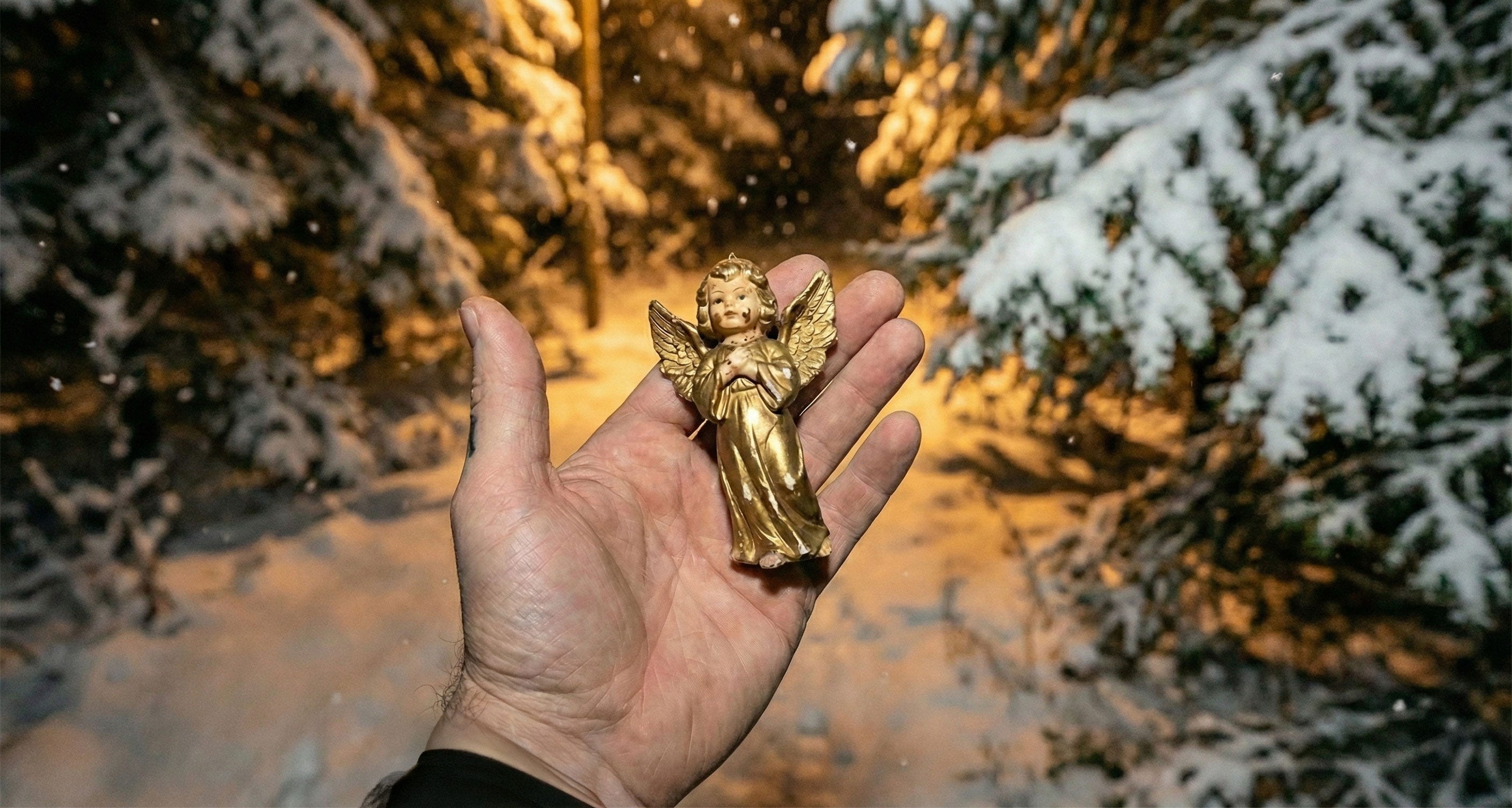
He reached into his pocket and felt the chipped plastic of the angel. His fingers were already going numb, a familiar, biting frost that made him think of Sam.
“Okay, angel,” he whispered, his teeth beginning to chatter. “Which way?”
He began to walk, following the road until it seemed to narrow into nothingness, his boots sinking into six inches of fresh powder. Just as the last of his strength began to ebb, he saw it—a jagged break in the wall of pines, a trail that looked like nothing more than a deer run. It didn’t lead toward a highway or a city; it led deeper into the silence.
He looked down at the angel in his hand, the flaking gold nearly swallowed by the absolute black of the night. “Are you sure about this?” he whispered, his voice lost in the dark. He looked up at the shadowed sliver of the trail. It felt like a threshold, a transition between the world he knew and something... else.
He stepped onto the path. As he walked, the atmosphere shifted, growing heavy and thick as if he were moving through water. The wind died down to a rhythmic hum, and the trees seemed to lean in, their frosted needles whispering secrets he couldn’t quite catch. Then, through the heavy, ethereal curtain of the storm, a faint, amber glow flickered. It wasn’t the neon glare of New York or the blinding halogen arrays of a stadium. It was the soft, warm light of a kerosene lamp, then another, until a small cluster of buildings appeared.
A sign, swinging precariously in the wind, read: WELCOME TO GABRIEL’S REST - EST. 2004.
The town looked like it had been preserved in amber. A single main street, a post office, and a diner with a flickering “Open” sign. But it wasn’t the lights that stopped Ben in his tracks.
It was the sound.
Faint, drifting through the heavy air from a small, stone-walled building at the end of the street, came the sound of a piano. The player was struggling, hitting a wrong note and stopping, then trying again with a hesitant, singular key. They were hunting for the melody, stumbling through the spaces between the chords like someone trying to recall a dream they’d almost forgotten.
And then, a voice followed—a soft, searching alto that seemed to be feeling its way through the dark. It wasn’t a rock star’s belt or a trained diva’s aria. It was a voice, slightly husky, as if it hadn’t been used for music in a long time. It was unhurried, raw, and hauntingly familiar. She was singing a carol—one Ben had done his best to avoid for twenty years—the same melody he’d hummed to a little girl in a hallway of white.
“...All is calm, all is bright.”
Ben stood in the middle of the street, the snow piling up on his shoulders, his heart hammering against his ribs. He looked down at his numb, trembling hand, uncurling his fingers just enough to see the chipped plastic angel one last time. The gold flakes seemed to catch the amber light of the town before his vision began to blur. The cold, which had been a biting companion for miles, suddenly felt heavy, like a shroud. He tried to take a step toward the stone building, toward the voice that shouldn’t exist, but his knees buckled. As he collapsed into the deepening powder, the angel remained clutched tight against his chest, and the sparkling white world went black.
Chapter Four
Inside the stone-walled building—a chapel that had been deconsecrated decades ago and served now as the town’s unofficial community hall—the air was thick with the scent of aged pine and the dry heat of a wood-burning stove.
A woman sat at the piano, her fingers hovering over the yellowed ivory keys. Her hair was pulled back into a practical knot, but there was a fragility in her posture that suggested she had never truly grown past the seven-year-old girl who had once lived in a hospital hallway.
Christmas was the hardest. Every year, when the calendar turned to December, the quiet of the mountains felt less like peace and more like a breath held too long. She had clawed her way through the first six winters of her childhood, outrunning a disease that the doctors had charted like a map to a dead end. But the seventh winter had arrived with a silence she couldn’t break. She still remembered the sterile glow of the hospital room on Christmas evening—the way the light had retreated from the walls, leaving behind the girl who never came home. They called it a peaceful passing, a transition into rest, but she only knew the cold. She had stayed behind in the stillness of Gabriel’s Rest, a lingering witness to a holiday that felt like a movie playing in a room she was no longer allowed to enter.
She struck a chord. It was wrong. She sighed, her movements slow and deliberate, as if the air itself were resisting her.
“I told them I would play this at the celebration this year, and by God I will,” she whispered, her voice sounding thin, like an echo caught in the rafters.
She began again, picking out the notes of Silent Night. She played it not for joy, but as a way to reach back through the twenty years of shadows to the night she had finally slipped beyond the world’s reach. She remembered the humming of the machines being drowned out by a soulful tenor voice. She remembered the warmth of a hand that had reached into her internal winter to drag her toward the light. An angel, she had called him. A miracle.
She remembered the hushed, clinical voice of the doctor in the hallway, explaining to her sobbing parents that the “angel” she’d described was merely a medication-induced vision—a trick of the mind born of pain and fading breath. He’d assured them that the experience was simply the brain’s way of processing the end, and though she’d seen her parents’ desperate need to believe her, the clinical coldness of the science had won out. But she had never stopped listening for the voice that had whispered her name in the dark.
“...Sleep in heavenly peace.”
The words felt like a plea.
She stood up to add a log to the stove, when a movement outside caught her eye. Through the narrow window, the storm was a white wall. But there, in the middle of the road, was a dark shape. A silhouette that shouldn’t be there. She watched as the figure—a man, she realized—looked down at his hand like it contained a miracle. Then he simply gave up, crumbling into the rising drifts.
“Oh God. No,” she breathed.
The sight of a life being swallowed by the white void was enough to trigger an instinct that bypassed the need for warmth. She didn’t stop for a coat; she simply threw open the heavy oak doors, the Adirondack wind screaming as it rushed into the sanctuary.
“Hello! Can you hear me?” she screamed, the wind tearing the words from her lips as soon as they were formed. Her voice was a desperate, thin thread against the roar of the mountain.
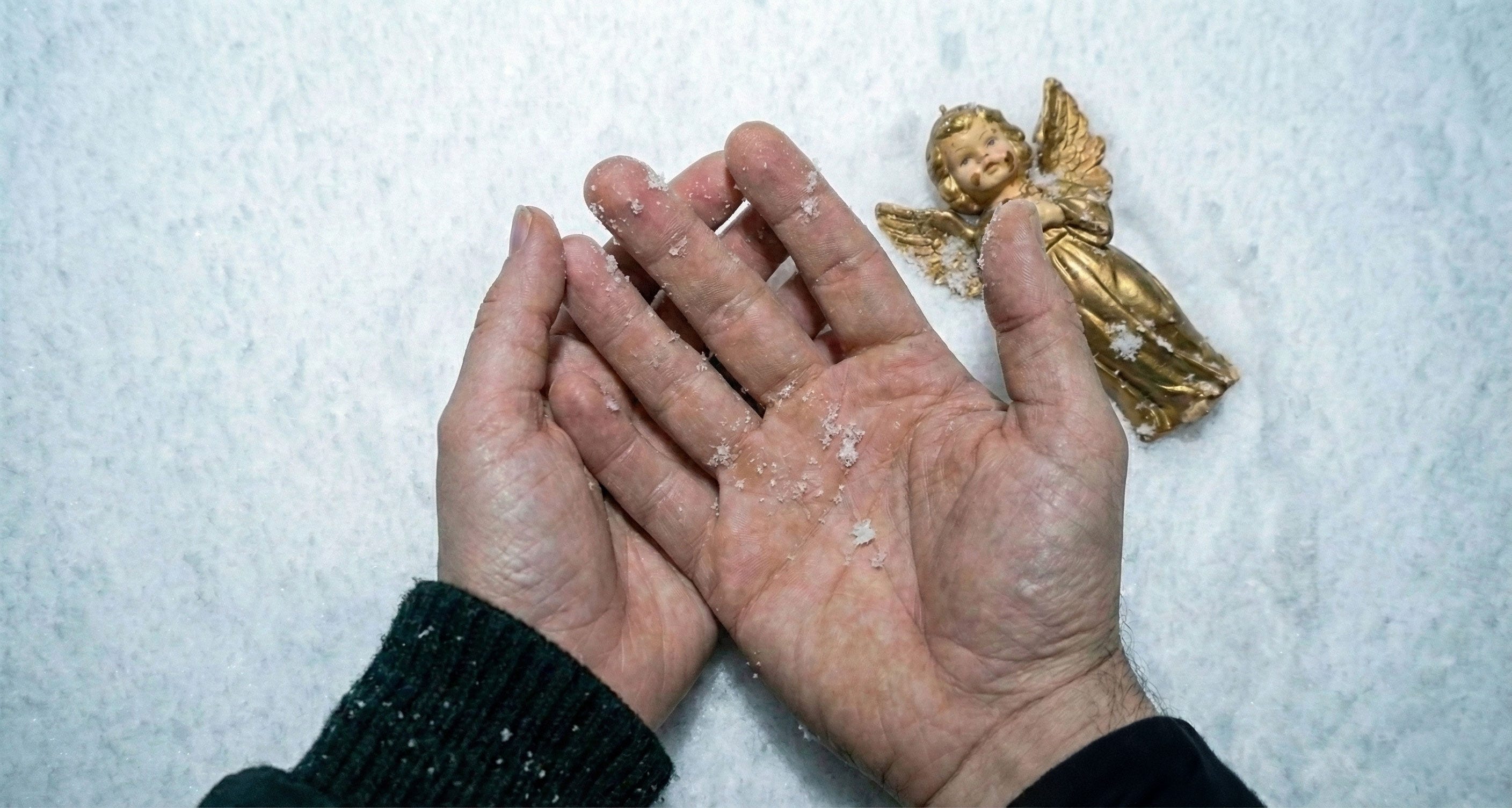
She ran into the knee-deep powder, her own breath coming in ragged gasps as she fought against the gale. She reached the spot where he’d gone down and dropped to her knees, her hands frantically clearing the drifts until she saw his face.
She froze. For a heartbeat, her world stopped. Underneath the hard lines of a man who had clearly lived through decades of shadows—the stubble, the weary creases at the corners of his eyes, the hollowed-out look of fame and regret—there was a ghost. A phantom sense of familiarity tugged at her, a resonance she couldn’t quite place, as if her heart recognized a connection that her mind had long since buried.
Could it be? The question was a dangerous flicker of light in a mind she had kept dark for twenty years. She shook the thought away, her fingers beginning to numb as she gripped his shoulders to drag him toward the chapel.
But as she heaved his weight, his right hand fell open, losing its grip on whatever he had been guarding so fiercely.
A small, chipped plastic angel tumbled into the snow.
She stopped breathing. She didn’t just recognize the flaking gold paint or the way the left wing was slightly shorter than the right. She felt the phantom prickle of the plastic in her own small palm from a lifetime ago. This wasn’t a stranger. The mountain hadn’t just sent her a traveler to save. It had sent her… him.
“Ben,” she whispered, the name a jagged sob that the wind immediately swallowed.
The urgency that had driven her into the snow for a stranger was suddenly eclipsed by a raw, staggering desperation. It wasn’t just a life in her arms anymore; it was her anchor, her miracle, her angel.
She reached down, her fingers brushing the cold plastic of the angel, and tucked it lovingly into her own pocket before reaching under his arms to pull him close. As she heaved, their cold cheeks met for a fleeting second, and a jolt like liquid fire surged through her—a searing, impossible heat that cut through the mountain’s freeze. Gritting her teeth against the wind, she began to drag him through the drifts, moving toward the amber light and the waiting warmth of the sanctuary.
Chapter Five
The first thing Ben sensed wasn’t the heat. It was the scent of home—cedar, woodsmoke, and the waxy, heavy sweetness of burning tallow. It was a dense, comforting cloud that seemed to pull the Adirondack frost right out of his marrow.
He didn’t open his eyes immediately. He was disoriented, his mind still spinning with the image of a logging trail and a shredded tire. But the sound... that was what truly brought him back.
Plink. Plink-plink.
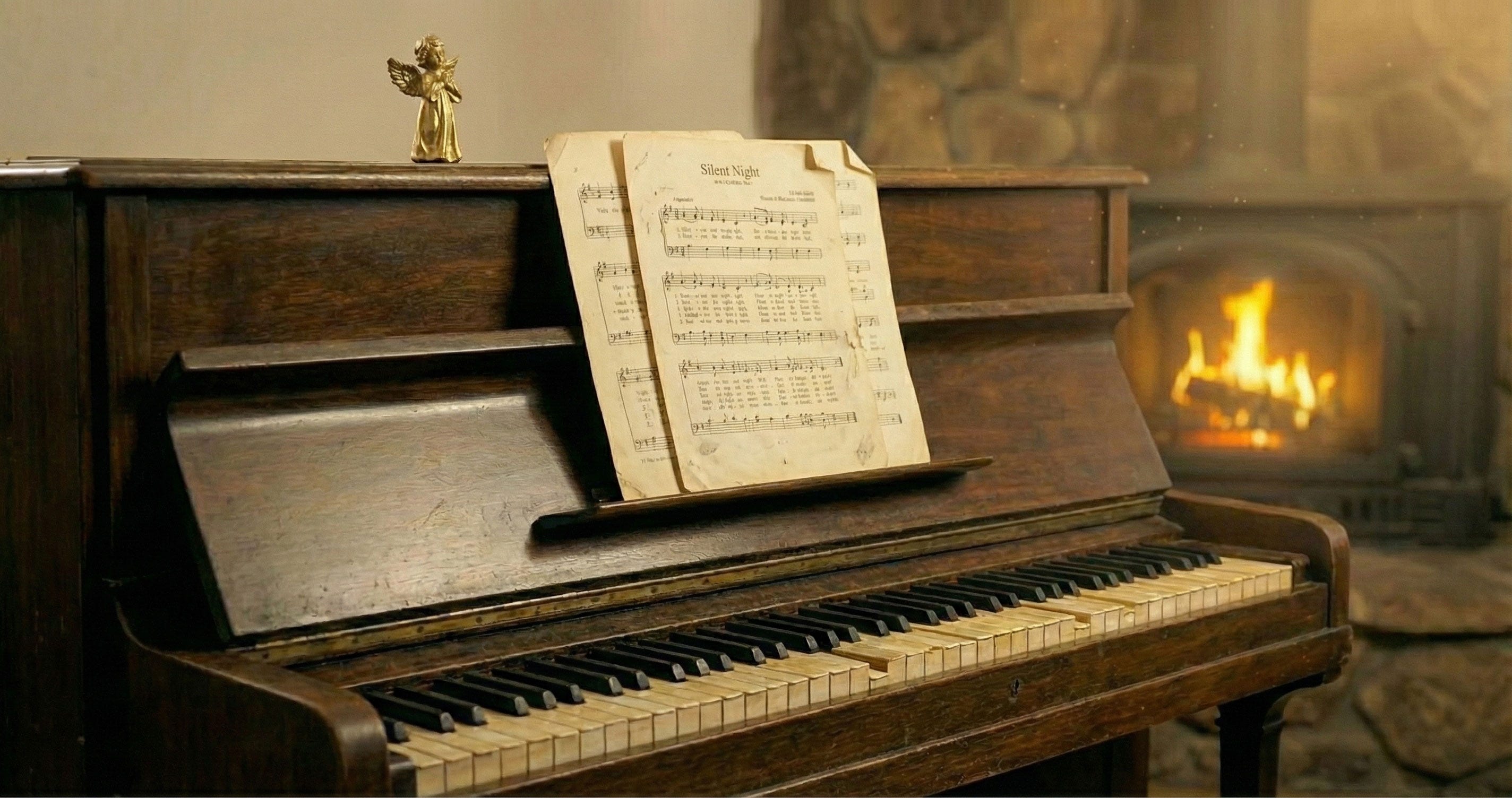
It was a piano. An old, upright piano by the sound of it, with a slightly out-of-tune G-sharp that vibrated against the stone walls of wherever he was. The player was hesitant. They would hit a few notes and then stumble. A wrong note would ring out, followed by a long, frustrated silence, and then the same three notes would try again.
Sleep... in...
A clashing minor chord. Then silence.
Ben opened his eyes. He was lying on a thick, braided rug in front of a massive cast-iron stove. The orange glow of the fire danced across the ceiling, which was made of heavy timber and rough-hewn stone.
He turned his head. A woman was sitting at the piano across the room. Her back was to him, her hair pulled into a loose knot, her shoulders slumped in a way that suggested she had never truly grown past the stuttering progress of her music. She reached up to rub her neck, the movement slow and weary, her focus entirely on the yellowed keys in front of her as if the melody were a puzzle she couldn’t quite solve.
“Wh... where am...?” Ben rasped as he tried to raise his head. His voice was a wreck, a dry scrape of sound that barely carried across the rug.
The woman froze. She didn’t turn around at first. Her hands stayed poised over the keys, trembling slightly.
“Safe,” she whispered. Her voice was rich and weathered by years of mountain air, sounding as if it had been carved from the very stillness of the valley outside. Yet it held an undertone that he—even through his fogginess—found himself straining to reach for, a resonant quality that seemed to steady the very air around him.
She turned slowly. In the flickering firelight, her face was soft but shadowed, etched with a quiet, mountain-grown strength. She looked at him with an intensity that Ben couldn’t place—a gaze that felt like a bridge being built across a dark canyon.
“Where...” Ben’s voice failed him. He tried to sit up, but his limbs felt heavy, as if he were still buried under the Adirondack snow. Suddenly, a jolt of alarm cut through his lethargy. He began to pat the sides of his thin denim jeans, his hands trembling as they found only empty fabric. With a grunt of effort, he shoved aside the heavy quilt he had been covered with, his eyes wide as he scanned the floor and the rug around him.
“The ornament,” he breathed, his voice hitching with a mounting, desperate panic. “I had an ornament. A gold angel. I can’t—I can’t have lost it.”
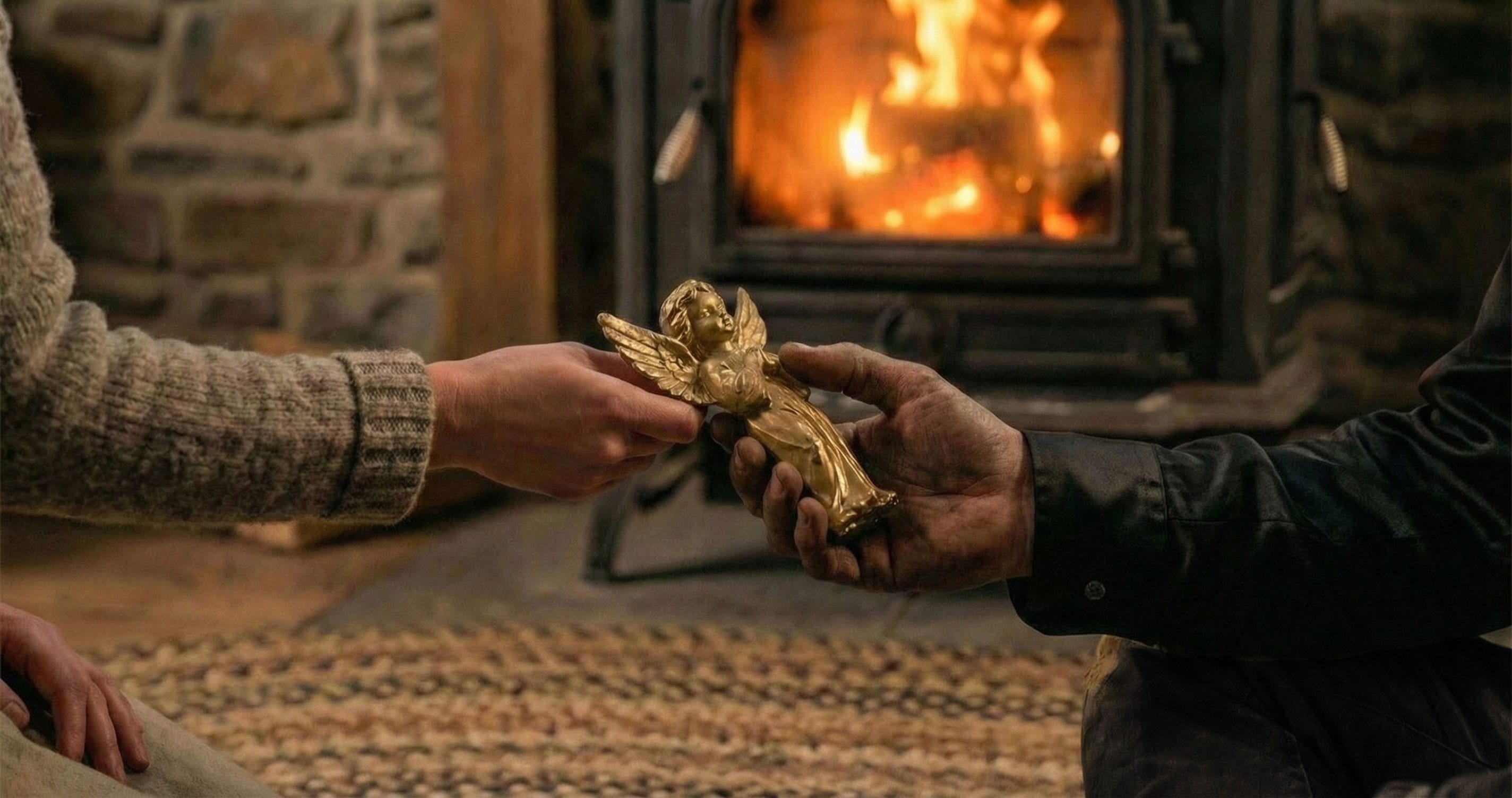
“Take it easy, Ben,” she said softly, standing up. She walked toward him, her footsteps making no sound on the wide wooden planks of the floor. She knelt beside him, placing a gentle, grounding hand on his shoulder until his frantic breathing began to slow. “You need to take it slow... You nearly froze to death in that storm.” She reached into her sweater pocket and pulled out the chipped plastic angel. “I have it. You’ve carried this a long way.”
As she handed it back, their fingers brushed. That same jolt of liquid fire he had felt in the drifts returned, a soul-signature that made his heart skip, yet his mind remained clouded by the weight of the transition.
“How do you know my name?” Ben asked, his voice barely a whisper as he clutched the angel.
The woman looked into the fire, a small, sad smile playing on her lips. “Everyone knows Ben Thorne,” she said, her voice sounding far away. “The radio plays The Echoes even up here in the peaks. I’ve been listening to your songs for a long time... but that one about the little girl? That was always my favorite.
Chapter Six
The next few days were a strange, shimmering blur. Ben recovered in a small guest room at the back of the chapel, but the recovery felt less like healing and more like a shedding of the man he had been.
He noticed things. The air in Gabriel’s Rest had a different weight—it was cleaner, tasting like the first breath of spring even when the white wall of the storm pressed against the glass. He was never hungry, though the woman brought him mugs of tea that smelled of winter spices. The tea was always perfectly hot, yet the mug never burned his hands. And the clock on the chapel wall—an ancient, brass-weighted thing—never seemed to move past 11:55 PM.
“The town square is beautiful,” the woman told him on the third morning, as she sat on the edge of his bed. “Everyone is preparing for the celebration. It’s the one night of the year when the Rest truly opens up.”
“What celebration?” Ben asked. He found his voice was returning, losing the gravel of the city and finding a resonance he hadn’t felt since he was seventeen.
“The Christmas Eve Concert,” she said, her eyes lighting up with that same defiant sparkle he saw in the firelight. “I’d convinced myself this would finally be the year. I even promised them I would play Silent Night at the celebration... I’ve been practicing for what feels like a lifetime. But I guess I was just never meant to play.”
Ben managed a small, tired smirk. “I heard you playi—um, practicing.”
She let out a breathy laugh, the sound warmer than the wood stove. “You caught that, did you?”
Ben reached out and took her hand. Her skin was warm, vibrant, and alive—more alive than anything he had known in the world of pyro and noise. He still didn’t know her name, or why her presence felt like a forgotten prayer, but as he looked at her, he felt a strange, rhythmic pulse in his chest.
“But you sing,” he said, the words slipping out before he could think about them. It wasn’t a question; it was a realization that seemed to hum in the very air between them.
The woman went still, her gaze searching his, a flicker of something ancient and hopeful crossing her face.
“I... do,” she whispered.
Ben looked down at his hands, then back at her. “I’m a little rusty and, well,” he raised his frostbitten fingers, the tips still tinged with a fading, ghostly blue, “this might slow me down, but I bet we could find the notes.”
“Then find the music with me.” She reached out and took both of his hands in hers, pulling them close to her heart. As her skin met his, Ben felt a sudden, profound shift—the ghostly blue at his fingertips began to recede, and the lingering ache of the Adirondack frost vanished as if it had never been there at all.
They spent the afternoon at the piano. Ben sat on the bench beside her, his large hands hovering over hers. When she faltered, he didn’t just tell her the note; he placed his fingers over hers and guided them. The physical touch sent pulses of heat through both of them, the shared rhythm of their movements grounding them even as the clock on the wall refused to move.
As the winter sun dipped behind the jagged peaks, casting long, violet shadows across the chapel floor, the practice didn’t feel like work anymore; it felt like a homecoming. The stuttering notes, still not perfect, finally began to smooth—a quiet promise between two souls.
By the time the first stars began to pierce the Adirondack indigo, the mist outside had lifted, revealing a town square that was filling with people, hundreds of them, all dressed in their Sunday best. They weren’t moving toward a stadium or a show; they were gathering in a quiet, expectant circle, their faces toward the chapel. They were preparing to witness a miraculous harmony that had been twenty years in the making.

Chapter Seven
The night air in the town square was impossibly still, as if the entire Adirondack range were holding its breath. The cold was no longer a predator; it was a companion, sharp and clean against the skin. Candles were passed from hand to hand, looking like a grounded constellation reflected against the deep blue of the snow. At the center of the square stood a small, wooden platform with an old upright piano, decorated with pine boughs and bright red holly—the centerpiece, a small plastic angel that seemed to glow under the amber lanterns.
Ben walked beside the woman, his boots crunching on snow that felt more like stardust than ice. As they reached the platform, the crowd parted in a silent, respectful wave. There was no cheering, no chanting, and no flashing of cell phone cameras—only a profound, living silence that tasted of peace. He saw faces that stirred a strange, ancient resonance within him—flickers of people he had once known, or perhaps had lost along the way. A neighbor from his youth, a teacher whose voice had long been silent, the elderly nurse who had once offered him a steadying hand. They watched not with curiosity, but with an expectant, timeless peace, as if they had been waiting for this single moment in time.
“Are you ready?” the woman whispered, her hand trembling slightly in his as they stepped onto the wooden planks.
“Always,” Ben replied.
They sat on the bench together, the worn wood smooth beneath them. Ben took a breath, and for the first time in twenty years, it didn’t feel heavy with the weight of expectation or the grit of the city. It was just air—pure and cold. He looked at his hands, resting on the keys. The blue was gone, replaced by a warmth that seemed to radiate from his very center.
“Why have you never told me your name?” Ben asked, searching her face in the lantern light.
She smiled softly, her eyes shining with that familiar, defiant light that had once greeted him in a hospital hallway. “You never asked.”
He placed his hands on the keys, and she placed hers atop his, her touch grounding him, pulling the melody from his memory like a thread of gold. As the first chord rang out, vibrating through the wood of the platform and the stillness of the square, she leaned toward his ear.
“It’s Sam,” she whispered. “Short for Samantha.”
The world began to change.
The melody flowed effortlessly, a soaring, celestial harmony that no human composer could have written. It was the song he had hummed to a little girl, the song he had sold for platinum records, and the song she had carried through twenty years of shadows—all distilled into a single, perfect resonance. As they began to sing together, their voices braided into a shimmering strand of sound. Ben’s no longer a rock star’s practiced belt; it was the rich, soulful tenor of a seventeen-year-old boy, finally understanding the weight of every lyric. Beside him, the tiny, clear bell of Samantha’s childhood, now a resonant alto, carried the melody with a strength that defied the years of silence. Together, they found the harmony they had been promised in a hospital hallway, two decades ago.
With every note, the town square began to blur. The people, the candles, the old buildings—they all began to ripple and dissolve into a cathedral of pure, shimmering light. The “human” weight of their forms began to lift. Ben watched as the creases of fame and fatigue vanished from his own hands, replaced by a radiant, silver glow. Beside him, the woman was transforming, her silhouette softening and expanding until she looked like a captured star.
He looked into her eyes and finally, truly, saw her. Not as the woman from the mountains, but as the girl who’d held his hand in that long-ago hallway, now grown into the light she was always meant to be. The lopsided snowflake hat and the hospital gown dissolved like shadows, replaced by an iridescent peace that shimmered with the radiance of twenty years finally set free.
“Sam,” he breathed, the name no longer a painful memory, but a perfect harmony.
“Ben,” she smiled, her voice now a tiny, clear bell that rang through the foundations of existence, echoing off the peaks and rising into the starlight.
As the final chord faded into the light, the great clock tower above the square—the one that had stood frozen at 11:55 for as long as any soul could remember—shuddered. With a sudden, metallic sigh of relief, the minute hand jerked forward. One tick. Two. On the final stroke, the heavy gears shifted into place, and the first bell of midnight rang out through the valley. The wait was over; Christmas Day had finally arrived.
The stone walls of the world fell away entirely. There was no more Adirondack winter, no more hospital halls, and no more stadium lights. There was only the music, and the two souls who had finally, at long last, finished their song.
You write the most beautifully detailed stories that spellbind me to the end. The words you use to describe the scenes and characters make them real. I am immersed in the world of the story as I read it. Thank you for this amazing gift of art through words and music. What a wonderful story. Merry Christmas and Happy New Year!
😭😭😭😭😭
I'm going to cry, this is such a wonderful story 😭